


RepMold is an emerging term used to describe a digitally driven approach to mold manufacturing that combines artificial intelligence, computer-aided design, simulation, automation, precision fabrication, and quality control. The main goal is simple: help manufacturers create accurate molds faster while reducing material waste, production errors, and unnecessary costs.
- What Is RepMold?
- Why RepMold Is Getting Attention
- How RepMold Technology Works
- 1. Digital Product and Mold Design
- 2. Design Analysis and Simulation
- 3. AI-Assisted Optimization
- 4. Mold Fabrication
- 5. Inspection and Quality Verification
- The Role of Artificial Intelligence in RepMold
- RepMold and Digital Twins
- Major Benefits of RepMold
- Faster Mold Development
- Improved Precision
- Reduced Material Waste
- Lower Long-Term Costs
- Faster Prototyping
- Greater Scalability
- RepMold vs. Traditional Mold Manufacturing
- RepMold and Injection Molding
- RepMold and Additive Manufacturing
- Industries That Could Use RepMold
- Automotive Manufacturing
- Medical Device Manufacturing
- Aerospace
- Consumer Electronics
- Industrial Equipment
- RepMold for Small and Medium-Sized Businesses
- Challenges and Limitations of RepMold
- High Initial Investment
- Data Quality Problems
- Need for Skilled Engineers
- Integration Problems
- AI Model Reliability
- Cybersecurity Risks
- How to Evaluate a RepMold Solution
- What Problem Does the System Solve?
- What Data Does the AI Need?
- How Is Quality Verified?
- Can the System Scale?
- Does It Integrate With Existing Systems?
- RepMold and Sustainability
- The Future of RepMold Technology
- More Advanced Generative Design
- Better Digital Twins
- Real-Time Process Control
- Greater Human-AI Collaboration
- Is RepMold a New Manufacturing Standard?
- RepMold Search Intent and Online Information
- Frequently Asked Questions About RepMold
- What does RepMold mean?
- Is RepMold an AI technology?
- How does AI improve mold manufacturing?
- Can RepMold replace traditional mold making?
- Is RepMold suitable for injection molding?
- Can RepMold be used for prototypes?
- Does RepMold reduce manufacturing costs?
- Does RepMold require 3D printing?
- What materials can be used with RepMold?
- Is RepMold suitable for medical manufacturing?
- How accurate is RepMold?
- Is RepMold the same as injection molding?
- Can small businesses use AI-driven mold manufacturing?
- What is the biggest benefit of RepMold?
- What is the biggest risk of AI-based mold manufacturing?
- Is RepMold part of Industry 4.0?
- Conclusion
The idea behind RepMold fits into a much larger change taking place across modern manufacturing. Factories are moving away from processes that depend only on manual adjustments and repeated physical testing. Instead, manufacturers are using digital models, machine learning, sensors, simulation, robotics, and automated inspection to make production more predictable.
It is important to make one distinction at the beginning. RepMold does not appear to be a universally standardized technical term or a single globally defined manufacturing standard. Current online references use the name in somewhat different ways. Some describe it as AI-assisted mold manufacturing, while others use it more broadly for digital mold replication, rapid prototyping, or advanced injection-molding workflows.
Therefore, the most useful way to understand RepMold is as an emerging concept around smarter, digitally supported mold production rather than assuming that every company using the name offers exactly the same technology.
For manufacturers in the United States, this distinction matters. A business considering an AI-based mold solution should evaluate the actual software, machines, materials, inspection methods, certifications, and production results rather than relying on the name alone.
What Is RepMold?
RepMold can be understood as an advanced mold manufacturing workflow that uses digital engineering and intelligent automation to improve the way molds are designed, produced, tested, and maintained.
In a traditional workflow, an engineer may create a mold design, send it to a machinist, manufacture the tooling, test it, identify problems, make physical changes, and repeat the process. Each additional revision can add time and cost.
A digitally driven RepMold workflow attempts to move more of that problem-solving into the digital stage.
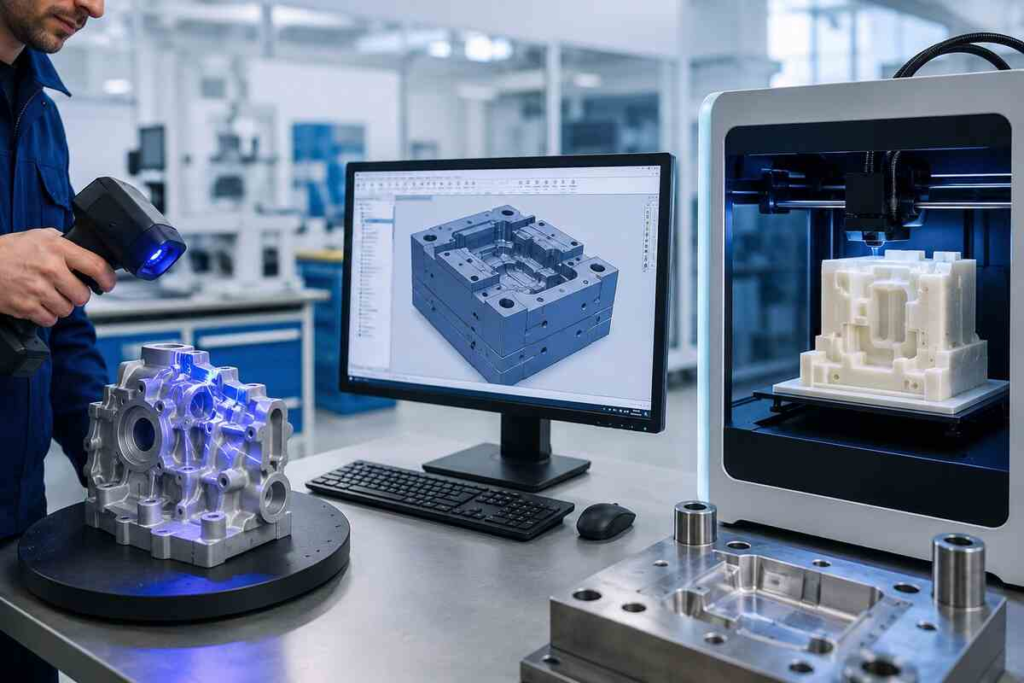
A simplified process looks like this:
- A product or mold is modeled digitally.
- Engineering software analyzes the geometry.
- AI or optimization tools may identify potential problems.
- Simulation can estimate material flow, cooling, stress, or other conditions.
- A mold is produced using CNC machining, additive manufacturing, or another suitable fabrication method.
- Sensors and inspection equipment collect production data.
- The results are compared with design requirements.
- Engineers refine the process when necessary.
- Production can then be scaled after the process is validated.
This approach connects closely with the broader Industry 4.0 movement. NIST describes advanced manufacturing as increasingly dependent on data, artificial intelligence, digital twins, sensing, modeling, and process control.
The central idea is not that AI replaces engineers. Instead, AI can help engineers make better decisions by analyzing large amounts of manufacturing information and identifying patterns that may be difficult to see manually.
Why RepMold Is Getting Attention
Manufacturing companies face several pressures at the same time.
Customers expect products to arrive quickly. Product designs change frequently. Production costs remain important. Quality requirements can be strict. At the same time, companies are under increasing pressure to reduce material waste and energy use.
Mold manufacturing sits directly in the middle of these challenges.
A mold can influence the quality, speed, consistency, and cost of an entire production process. If a mold has dimensional problems, poor cooling, an inefficient gate design, or another engineering issue, the resulting problem may affect thousands of manufactured parts.
This is why digital mold engineering is important.
Instead of discovering every problem after a physical mold has already been produced, engineers can use CAD, CAE, simulation, AI-assisted optimization, and inspection systems to identify potential issues earlier.
NIST research into advanced digital manufacturing similarly emphasizes the value of machine learning, digital twins, process monitoring, and data-driven methods for reducing uncertainty and supporting first-part-correct manufacturing.
RepMold is therefore best viewed as part of a larger manufacturing transformation.
How RepMold Technology Works
The exact RepMold workflow can vary by application, equipment, and manufacturer. However, a modern AI-assisted mold manufacturing system can generally be divided into several stages.
Also Read: Adultsrach: A Comprehensive Guide
1. Digital Product and Mold Design
The process begins with a digital model.
Engineers typically use computer-aided design, commonly called CAD, to define the product geometry and mold structure. The digital model may include dimensions, tolerances, cavities, cores, cooling channels, gates, vents, ejector locations, and other engineering details.
A good digital model provides a common reference for the entire production process.
This is important because errors introduced at the beginning can become much more expensive later.
2. Design Analysis and Simulation
After the mold is modeled, engineers can use simulation tools to study how the design may behave.
Depending on the manufacturing process, simulation can examine areas such as:
- Material flow
- Cooling behavior
- Thermal distribution
- Pressure
- Shrinkage
- Warpage
- Mechanical stress
- Air trapping
- Potential weak areas
- Cycle time
Simulation does not guarantee that the final mold will work perfectly. Real-world materials and machines can behave differently from simplified computer models.
However, simulation can reduce the amount of physical trial and error needed during development.
3. AI-Assisted Optimization
This is where the artificial intelligence aspect becomes particularly important.
An AI system can analyze historical manufacturing data and identify relationships between design choices, process settings, materials, and production results.
For example, a machine-learning model could potentially identify patterns associated with:
- Higher defect rates
- Longer cycle times
- Excess material usage
- Cooling problems
- Dimensional variation
- Tool wear
- Production instability
AI can also support design optimization by comparing multiple possible configurations.
The objective is not simply to make a design more complicated. The objective is to find a design that balances performance, manufacturability, cost, durability, and production speed.
NIST research shows that AI and machine learning are being explored for process optimization, quality control, defect detection, material analysis, and other manufacturing tasks.
4. Mold Fabrication
Once the design is approved, the physical mold must be manufactured.
Depending on the application, this may involve:
- CNC machining
- Milling
- Turning
- Electrical discharge machining
- Grinding
- Additive manufacturing
- Hybrid manufacturing
- Surface finishing
The choice depends on the required accuracy, mold material, geometry, production volume, surface finish, and budget.
A digitally optimized design does not remove the need for high-quality manufacturing equipment.
Precision still depends on machine capability, calibration, tooling, material properties, operator expertise, and inspection.
5. Inspection and Quality Verification
Inspection is one of the most important stages of modern mold manufacturing.
A mold can look correct but still have dimensional errors that affect the final product.
Manufacturers may use coordinate measuring machines, optical scanners, vision systems, gauges, or other metrology equipment to compare the physical mold against its digital specification.
This creates a digital feedback loop.
The design says what the mold should be.
The manufacturing process creates the mold.
Inspection determines what was actually created.
The resulting data can then help engineers improve future production.
The Role of Artificial Intelligence in RepMold
AI is often presented as the most exciting part of RepMold, but it is important to understand what AI actually contributes.
Artificial intelligence does not automatically make a mold precise.
Instead, AI can help process large quantities of information and make predictions or recommendations based on available data.
AI for Mold Design
AI-assisted design can evaluate different design possibilities.
For example, an optimization system might examine several cooling-channel layouts and identify one that provides more uniform cooling while meeting space and manufacturing limitations.
This can be useful because mold design often involves many competing variables.
A human engineer might need to evaluate dozens of design factors at the same time. An algorithm can rapidly evaluate large numbers of possible combinations.
The final decision, however, should still be reviewed by qualified professionals.
AI for Defect Prediction
AI can also help predict potential defects.
If a manufacturer has enough reliable historical data, machine-learning systems can learn relationships between manufacturing conditions and defects.
Possible applications include predicting:
- Warpage
- Dimensional variation
- Surface defects
- Incomplete filling
- Cooling problems
- Tool wear
- Process instability
The usefulness of such a system depends heavily on data quality.
Poor data produces unreliable predictions.
AI for Quality Control
Computer vision is another important application.
A camera-based system can inspect manufactured parts or mold surfaces and compare them with known quality requirements.
This can help detect defects faster and create a consistent inspection process.
NIST research into AI-enabled manufacturing highlights computer vision, predictive analytics, digital twins, and process monitoring as important areas of development.
Also Read: Messeregge: Everything You Need to Know
AI for Predictive Maintenance
Molds and manufacturing equipment experience wear.
Instead of waiting for a failure, an intelligent system can analyze information such as operating time, temperature, pressure, vibration, cycle count, and inspection results.
The system may then identify signs that maintenance could be needed.
Predictive maintenance can reduce unexpected downtime and help manufacturers plan maintenance around production schedules.
RepMold and Digital Twins
Digital twins are another important technology associated with advanced manufacturing.
A digital twin is a virtual representation of a physical object, machine, process, or system. NIST describes digital twins as synchronized virtual models that can help manufacturers represent, diagnose, predict, and optimize operations.
In a RepMold-style workflow, a digital twin could represent a mold and its production behavior.
The digital model might contain information about:
- Mold geometry
- Material
- Machine settings
- Production history
- Inspection results
- Maintenance records
- Temperature
- Pressure
- Cycle time
- Tool wear
As new data becomes available, the digital representation can become more useful.
This creates a feedback system between the physical factory and the digital environment.
Major Benefits of RepMold
Faster Mold Development
One of the biggest potential advantages is speed.
Digital design, simulation, automated machining, and AI-assisted optimization can reduce unnecessary iterations.
When engineers identify problems before manufacturing, fewer physical corrections may be required.
This can shorten the development cycle.
Improved Precision
Precision is critical in mold manufacturing.
Small dimensional differences can affect the final part.
Digital design and computer-controlled manufacturing can improve repeatability, while automated inspection can help identify deviations.
AI may further support precision by identifying patterns in production data.
Reduced Material Waste
Waste can occur when manufacturers repeatedly produce failed prototypes, remove excess material during machining, or discard defective parts.
Better planning can reduce some of this waste.
AI and simulation can also help engineers explore designs before physical manufacturing begins.
However, waste reduction depends on the entire production system, not AI alone.
Lower Long-Term Costs
RepMold may reduce costs by decreasing:
- Rework
- Scrap
- Downtime
- Manual inspection
- Development delays
- Unnecessary material consumption
The technology can require significant initial investment, so the financial benefit depends on production volume and application.
Faster Prototyping
Rapid prototyping is particularly valuable when companies need to test a new product design.
Instead of spending a long time building final production tooling immediately, manufacturers can use digital workflows and rapid manufacturing techniques to test concepts earlier.
This supports faster product development.
Greater Scalability
A well-designed digital manufacturing workflow can be easier to scale because digital files, process parameters, inspection data, and production records can be shared across compatible systems.
Scalability does not mean that every factory can produce identical results automatically.
Machines, materials, environmental conditions, and quality systems still matter.
RepMold vs. Traditional Mold Manufacturing
Traditional mold manufacturing remains highly valuable.
Experienced mold makers have developed reliable methods for producing complex tooling for many decades.
The main difference is how much of the process is digitally optimized.
Traditional workflows may rely more heavily on:
- Manual adjustments
- Physical prototypes
- Machining experience
- Repeated testing
- Human inspection
- Manual documentation
A modern RepMold-style workflow may add:
- CAD automation
- Simulation
- AI-assisted design
- Digital twins
- Automated inspection
- Machine monitoring
- Data analytics
- Predictive maintenance
This does not mean traditional methods disappear.
In practice, advanced manufacturing usually combines human expertise with digital tools.
That hybrid approach is likely to remain important because engineering judgment is still required when designs involve unusual materials, safety-critical requirements, complex geometries, or incomplete data.
RepMold and Injection Molding
Injection molding is one area where advanced mold technology can have a major impact.
Injection molding works by placing material into a mold cavity and allowing it to take the required shape.
The mold must be carefully designed because factors such as cooling, material flow, pressure, shrinkage, and ejection can affect the final product.
AI-assisted systems may help engineers evaluate these factors before production.
For example, a digital simulation could identify an area where material flow may be uneven. Engineers could then change the gate location or mold geometry before the mold is manufactured.
This can reduce the risk of expensive redesign.
RepMold and Additive Manufacturing
Additive manufacturing, often called 3D printing, is another technology closely related to digitally driven mold production.
NIST explains that additive manufacturing creates parts directly from three-dimensional digital information and can support complex geometries, customization, and rapid design-to-product workflows.
For mold manufacturing, additive techniques can potentially be used for:
- Prototype molds
- Inserts
- Complex tooling
- Conformal cooling structures
- Low-volume production tooling
- Customized tooling
Additive manufacturing does not replace CNC machining in every situation.
Instead, the two technologies can complement one another.
A hybrid approach may use additive manufacturing for complex internal structures and machining for surfaces that require very tight tolerances or specific finishes.
Industries That Could Use RepMold
Automotive Manufacturing
Automotive companies produce large numbers of components with strict dimensional requirements.
Advanced mold manufacturing can support:
- Interior components
- Exterior components
- Electrical housings
- Clips
- Brackets
- Functional plastic components
- Prototype parts
Shorter development cycles are particularly useful in an industry where vehicle designs change frequently.
Medical Device Manufacturing
Medical manufacturing requires careful quality control.
Molds may be used to produce components for medical equipment, laboratory products, packaging, and other applications.
AI and digital manufacturing can support quality management, but medical applications require appropriate validation and regulatory controls.
A manufacturer should never assume that an AI-generated design is automatically suitable for a medical application.
Aerospace
Aerospace manufacturing places strong demands on precision, repeatability, documentation, and material performance.
Advanced digital manufacturing can support tooling and component development, but aerospace applications often require extensive testing and qualification.
Consumer Electronics
Consumer electronics often require small parts with precise dimensions and attractive surface finishes.
Digital mold design can help manufacturers respond quickly to changing product designs.
Industrial Equipment
Industrial equipment manufacturers can use advanced mold technology for housings, seals, components, fixtures, and other parts.
The ability to create custom tooling can be useful when production volumes are not large enough to justify conventional tooling approaches.
RepMold for Small and Medium-Sized Businesses
Large manufacturers are not the only companies that can benefit from digital mold technology.
Small and medium-sized businesses may use digital workflows to reduce development time and compete with larger companies.
For a smaller company, the biggest advantage may not be maximum automation.
Instead, it may be the ability to make design changes quickly.
ALso Read: Voddler.co.uk: The Website, Its Content, Streaming Topics, Safety
A small manufacturer can create a digital design, test it, produce a prototype, inspect it, and make another revision without rebuilding the entire development process from the beginning.
However, smaller companies also face challenges.
AI systems require good data, trained employees, suitable equipment, cybersecurity, and reliable software.
A company should calculate the total cost of ownership before investing.
Challenges and Limitations of RepMold
RepMold should not be treated as a magic solution.
Every manufacturing technology has limitations.
High Initial Investment
Advanced software, sensors, inspection systems, machining equipment, and AI infrastructure can be expensive.
Companies must determine whether expected savings justify the investment.
Data Quality Problems
AI depends on data.
If historical production records contain errors, missing information, inconsistent measurements, or biased samples, an AI model may produce unreliable recommendations.
Good data management is therefore one of the foundations of intelligent manufacturing.
Need for Skilled Engineers
Automation does not eliminate the need for human expertise.
Manufacturing engineers still need to understand:
- Materials
- Mold design
- Tolerances
- Machine behavior
- Quality control
- Manufacturing economics
- Safety requirements
AI should support this expertise rather than replace it blindly.
Integration Problems
A factory may have equipment from several vendors.
Software systems may use different data formats and communication methods.
This can make integration difficult.
NIST has identified interoperability, standards, trustworthiness, and validation as important challenges for digital twins and advanced manufacturing systems.
AI Model Reliability
An AI system may produce an answer that looks convincing but is wrong.
Manufacturing companies therefore need validation procedures.
For high-risk applications, automated recommendations should be checked against engineering standards, physical tests, and established quality procedures.
Cybersecurity Risks
Digital manufacturing creates new cybersecurity concerns.
Mold designs, CAD files, production settings, supplier information, and inspection data may all be valuable intellectual property.
A connected factory therefore needs strong access controls, secure networks, backups, authentication, monitoring, and data governance.
How to Evaluate a RepMold Solution
Companies considering RepMold or a similar AI-based manufacturing system should ask practical questions.
What Problem Does the System Solve?
Do not start with the technology.
Start with the business problem.
Is the company trying to reduce mold development time?
Is scrap too high?
Are quality problems difficult to identify?
Is tooling maintenance unpredictable?
The best technology is the one that addresses a real problem.
What Data Does the AI Need?
Ask what information is required to train or operate the system.
Important questions include:
- Does it use historical production data?
- Where is the data stored?
- Who owns the data?
- Can the company export its data?
- How is confidential CAD information protected?
- How is model accuracy validated?
How Is Quality Verified?
A good manufacturing solution should have a clear inspection process.
Ask how the system measures dimensional accuracy and how deviations are documented.
Can the System Scale?
A solution that works for five prototypes may not work for 500,000 parts.
Manufacturers should evaluate performance at the expected production volume.
Does It Integrate With Existing Systems?
Compatibility with CAD, CAM, ERP, MES, PLM, inspection, and machine-control systems can have a major effect on implementation costs.
RepMold and Sustainability
Sustainability is becoming more important in manufacturing.
Reducing waste is one potential advantage of digitally optimized production.
If engineers can identify problems before producing physical prototypes, fewer materials may be consumed.
Better process control can also reduce defective parts.
More efficient production may reduce unnecessary machine operation and energy use.
However, it would be inaccurate to claim that RepMold is automatically environmentally friendly.
The environmental impact depends on the complete lifecycle.
Manufacturers should consider:
- Raw material sourcing
- Machine energy use
- Tool lifespan
- Scrap rates
- Recycling
- Transportation
- Maintenance
- End-of-life disposal
A digital manufacturing system can support sustainability, but actual results need to be measured.
The Future of RepMold Technology
The future of RepMold is closely connected to the broader development of smart manufacturing.
Several trends are likely to influence the field.
More Advanced Generative Design
AI systems are becoming better at exploring design alternatives.
Future tools may generate multiple mold concepts based on constraints such as cost, strength, cooling performance, manufacturing method, and production volume.
Better Digital Twins
Digital twins may become more detailed and useful as sensors and data systems improve.
A future mold could have a continuously updated digital representation showing its condition, production history, and predicted maintenance requirements.
Real-Time Process Control
Manufacturing systems are moving toward real-time monitoring.
Sensors can collect information while machines operate.
AI can then analyze this information and potentially identify problems earlier.
NIST research is actively exploring sensing, monitoring, feedback control, and data-driven manufacturing methods to improve quality and productivity.
Greater Human-AI Collaboration
The most realistic future is probably not fully autonomous factories everywhere.
Instead, humans and AI will increasingly work together.
AI can process large amounts of information quickly.
Engineers can provide context, judgment, creativity, and responsibility.
This combination can be stronger than either approach alone.
Is RepMold a New Manufacturing Standard?
No clear evidence shows that RepMold is currently a universally recognized manufacturing standard.
Online sources use the term in different ways, including descriptions involving AI-powered mold production, digital replication, injection molding, additive manufacturing, and rapid prototyping.
That means readers should be careful when they see strong claims about RepMold.
The underlying technologies are real and well established or actively researched.
These include CAD, CNC machining, injection molding, additive manufacturing, machine learning, computer vision, digital twins, and automated quality inspection.
But the name RepMold itself should not be treated as proof that a particular product or service has a specific performance level.
This is an important point for buyers and researchers.
Technology names can become popular before standards and terminology become consistent.
RepMold Search Intent and Online Information
People searching for “RepMold” may have different reasons for doing so.
Some may want a basic definition.
Others may be researching AI-driven manufacturing.
A manufacturer may be looking for mold production technology.
A student may be researching Industry 4.0.
A business owner may be comparing rapid prototyping and traditional tooling.
Search results currently include several articles describing RepMold as a digital, AI-assisted, or advanced mold manufacturing approach.
Because the terminology is still developing, readers should compare technical specifications rather than relying only on marketing language.
This is especially important when evaluating claims about accuracy, cost savings, production speed, scalability, or AI performance.
Also Read: InstaPV: The Anonymous Instagram Viewer
Frequently Asked Questions About RepMold
What does RepMold mean?
RepMold is an emerging term associated with digitally driven mold manufacturing and replication. It can refer to workflows that combine CAD, simulation, AI, automation, CNC machining, additive manufacturing, and quality inspection.
Is RepMold an AI technology?
Some current descriptions of RepMold specifically present it as AI-driven mold manufacturing. However, the term does not appear to have one universal technical definition. The actual AI capabilities depend on the particular system or workflow being described.
How does AI improve mold manufacturing?
AI can analyze production data, identify patterns, support design optimization, predict potential defects, assist quality inspection, and help with predictive maintenance.
Can RepMold replace traditional mold making?
Not necessarily. Traditional mold manufacturing remains important. RepMold-style technology is better understood as an advanced workflow that can improve or complement conventional engineering and fabrication methods.
Is RepMold suitable for injection molding?
The underlying technologies associated with RepMold can be useful for injection molding, particularly in mold design, simulation, optimization, cooling analysis, inspection, and production monitoring.
Can RepMold be used for prototypes?
Yes, digitally driven mold workflows can support rapid prototyping. Depending on the application, manufacturers may combine simulation, 3D printing, CNC machining, and other techniques to create prototype tooling.
Does RepMold reduce manufacturing costs?
It can reduce certain costs by lowering rework, scrap, development time, and downtime. However, the initial investment in software, equipment, training, and integration can be significant.
Does RepMold require 3D printing?
No. A RepMold-style workflow can use several manufacturing technologies. CNC machining, additive manufacturing, hybrid manufacturing, and conventional tooling may all be appropriate depending on the project.
What materials can be used with RepMold?
The material depends on the manufacturing process and application. Mold systems may use materials such as tool steels, aluminum alloys, engineering polymers, composites, or specialized materials designed for specific production conditions.
Is RepMold suitable for medical manufacturing?
The underlying digital manufacturing technologies can support medical manufacturing, but medical applications require appropriate validation, documentation, quality systems, and regulatory compliance. AI assistance does not remove those requirements.
How accurate is RepMold?
There is no single accuracy value for “RepMold” because the term describes an approach rather than one universally standardized machine. Accuracy depends on the CAD model, manufacturing equipment, material, process, calibration, tolerances, and inspection system.
Is RepMold the same as injection molding?
No. Injection molding is a specific manufacturing process. RepMold is a broader emerging term that may include technologies used to design and manufacture molds for injection molding and other processes.
Can small businesses use AI-driven mold manufacturing?
Yes. Small businesses can use digital design, simulation, rapid prototyping, automated inspection, and other technologies. However, they should evaluate costs, training needs, data requirements, and expected production volume before making an investment.
What is the biggest benefit of RepMold?
The biggest potential benefit is the ability to connect design, simulation, manufacturing, inspection, and data analysis into a more efficient workflow. This can help reduce unnecessary trial and error.
What is the biggest risk of AI-based mold manufacturing?
One major risk is trusting AI recommendations without proper validation. Manufacturing decisions should be checked against engineering requirements, physical measurements, testing, and applicable quality standards.
Is RepMold part of Industry 4.0?
The technologies commonly associated with RepMold fit well within Industry 4.0. AI, automation, sensors, digital twins, data analytics, and connected manufacturing are all important parts of the smart manufacturing movement.
Conclusion
RepMold is best understood as an emerging concept within the broader movement toward intelligent and digitally connected manufacturing. Its core promise is straightforward: use modern digital tools to make mold development more precise, efficient, flexible, and scalable.
The most important innovation is not AI by itself. The real value comes from connecting several technologies into one workflow. CAD creates the digital design. Simulation tests possible behavior. AI can identify patterns and recommend improvements. CNC machines or additive manufacturing systems create physical tooling. Sensors collect production information. Inspection systems verify the result. Digital records then provide information for future improvements.
This connected approach can help manufacturers reduce unnecessary trial and error while improving development speed and production consistency.
At the same time, RepMold should not be treated as a guaranteed replacement for traditional manufacturing. The term is still used inconsistently online, and the quality of a particular solution depends on its actual technology, data, equipment, engineering practices, and quality controls.
For U.S. manufacturers considering this type of technology, the best strategy is to focus on measurable outcomes. Look at dimensional accuracy, cycle time, scrap rates, tooling life, maintenance requirements, development time, integration costs, and return on investment.
The future of mold manufacturing will likely involve closer cooperation between engineers, machines, software, AI, sensors, and data. RepMold reflects that direction. Its long-term importance will depend not on the name itself, but on how effectively these technologies solve real manufacturing problems.
NIST’s continuing work in AI, digital twins, additive manufacturing, process monitoring, and advanced manufacturing shows that the underlying technological movement is real and actively developing.
For businesses, engineers, students, and technology researchers, the most useful way to approach RepMold is therefore with both interest and caution: understand the technology, verify technical claims, protect manufacturing data, validate AI recommendations, and measure real-world results.